Bree and Hwin's Enslavement in Calormen
The Horse and His BoyBree and Hwin's Enslavement in Calormen describes the captivity that shapes both horses’ lives before and during their flight toward Narnia. Taken when young, they are kept among humans and deprived of the freedom to live openly as talking horses; their escape becomes not only a journey out of Calormen but a test of what freedom requires of them and of the people travelling with them.
Identity and Conditions of Captivity
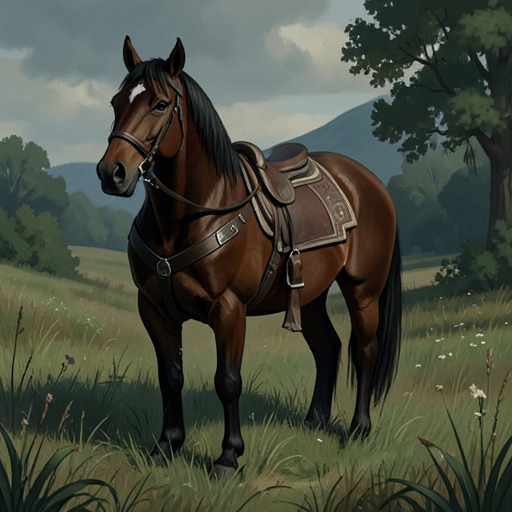
Bree says he was captured, stolen, or taken as a foal, after ranging beyond the Southern slopes despite his mother’s warning. His captivity lasts for years. Among humans he hides that he can speak, pretending to be dumb and witless like their other horses. The concealment is a survival strategy: he reasons that if his captors discovered his speech, they would exhibit him at fairs and guard him more carefully, closing off his last chance to escape.
The other horse’s history is parallel. Hwin, too, tells Bree that she was captured in early youth and has spent years enslaved among the Calormenes. Their matching histories establish that captivity is not an isolated misfortune for Bree but a condition shared by both horses. Though they have lived under human control, each retains a sense of identity that captivity has forced them to hide or negotiate.
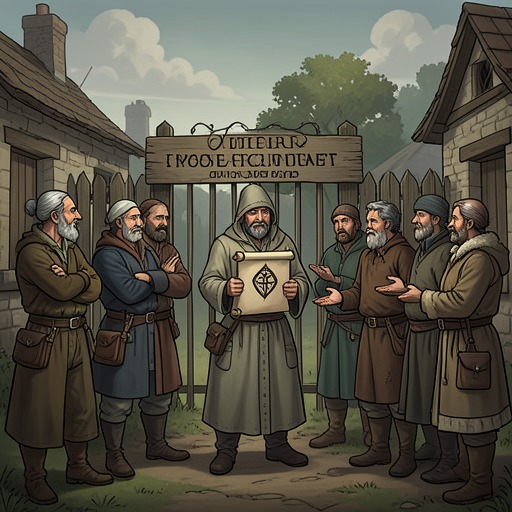
The wider world around them reinforces this contrast between freedom and subjection. In Calormen, Arsheesh’s household also depends on work imposed on a child: Shasta mends and washes nets, cooks supper, and cleans the cottage, while Arsheesh may find fault with or beat him. The circumstances are not identical to the horses’ enslavement, but they place the escape within a society where human authority can govern others through labor, punishment, and control of movement.
Escape and Shared Agency
When Bree meets Hwin and her human companion, Aravis, he recognizes the familiar outline of his own past in Hwin’s account: capture in youth followed by years of slavery. He then asks whether escape is the purpose of their journey. Hwin answers that it is, and that she and Aravis are trying to reach Narnia. Bree proposes that the four travellers continue together, offering Hwin the assistance and protection he can provide.
That offer carries a change in how the horses’ relationship to humans is understood. Bree objects to Aravis treating Hwin as her property: he insists that he and Hwin are free Narnians, and that if Aravis is trying to reach Narnia, she wants to become one as well. On that understanding, Hwin is no longer simply Aravis’s horse; the human and the horse are fellow travellers. Bree’s rebuke does not erase the practical dependence between rider and mount, but it challenges the language of ownership that captivity has made familiar.
The escape also requires choices shaped by confinement. When Shasta asks whether using money would be stealing, Bree initially admits he had not considered the question. He concludes that, as prisoners and captives in enemy country, they may treat the money as booty, and adds that they need it to obtain food for Shasta, who cannot live on grass and oats as a horse can. The reasoning makes the material consequences of flight explicit: getting away requires food for a human companion, and the captives must judge what is permissible under the conditions imposed on them.
Freedom, Shame, and the Cost of Flight
Bree’s understanding of captivity reappears after the lion attack. Believing himself unfit to return to the free horses of Narnia, he says he will go back to Calormen and slavery. He condemns himself for galloping away to save his own skin while leaving Hwin, Aravis, and Shasta exposed to the lions. His fear of returning as a free horse is bound to a moral judgment: he sees his flight from danger as proof that he does not deserve freedom.
Hwin contests that judgment, saying that all of them ran as hard as they could. Bree answers that Shasta, unlike him, ran back in the right direction. The contrast sharpens Bree’s shame: the boy he calls a child, with no sword and no good nurture or example, has acted with greater courage than the horse who boasted of a hundred fights. Bree’s declaration that he is fit only for slavery shows how captivity has become, for a moment, not merely a condition imposed by human captors but a verdict he passes on himself.
The episode therefore gives escape a moral dimension beyond reaching a destination. Bree’s hidden identity, Hwin’s parallel history, their decision to travel together, and Bree’s later impulse to return to bondage all reveal different pressures exerted by enslavement: enforced concealment, constrained choice, dependence on others, and the fear that past conduct has made freedom undeserved. The journey toward Narnia offers the possibility of life among free horses, but Bree must also confront the shame that threatens to make him surrender that possibility.